
Everyone’s talking about AI, but are businesses counting the full bill?
Summary
AI promises big results, but most businesses only budget for the license. Here’s what this article covers:
- What the true costs of AI actually are: The real expenses aren’t just the subscription fee. They live in data preparation, system integration, security, and ongoing management.
- Why data readiness is step one: Most organizations have fragmented, disorganized data that must be cleaned and structured before any AI tool can work safely or accurately.
- The integration problem nobody warns you about: Getting AI to connect with existing business systems often requires expensive custom development and ongoing usage costs that add up fast.
- Why security and compliance can’t be an afterthought: Without proper controls, employees may unknowingly expose sensitive data. Industries governed by HIPAA, GDPR, or SOC 2 face serious regulatory risk.
- The ongoing operational costs most budgets miss: AI requires continuous management, including cloud usage costs, fine-tuning, troubleshooting, and updates. It’s not a one-time setup.
- How the right IT partner changes the equation: Working with an MSP that understands both traditional infrastructure and modern AI helps businesses map out the full cost upfront and avoid expensive surprises.
The True Cost of AI
There’s a conversation happening in boardrooms and business owner circles everywhere right now. It usually sounds something like this: “We need artificial intelligence. Everyone else is using it. Let’s just grab a license and get going.”
We get it. The promise of AI is genuinely exciting. Faster workflows, AI-driven decisions, less time spent on repetitive tasks. But here at AtNetPlus, we’ve been called in more times than we can count to help rescue AI projects that looked great on paper and fell apart in practice. Almost every time, the technology itself wasn’t the problem.
It was everything around the technology that nobody planned for.
Consider this your honest, no-fluff guide to the hidden costs of AI, because the businesses that understand these things upfront are the ones that actually succeed.
The AI Iceberg Nobody Mentions
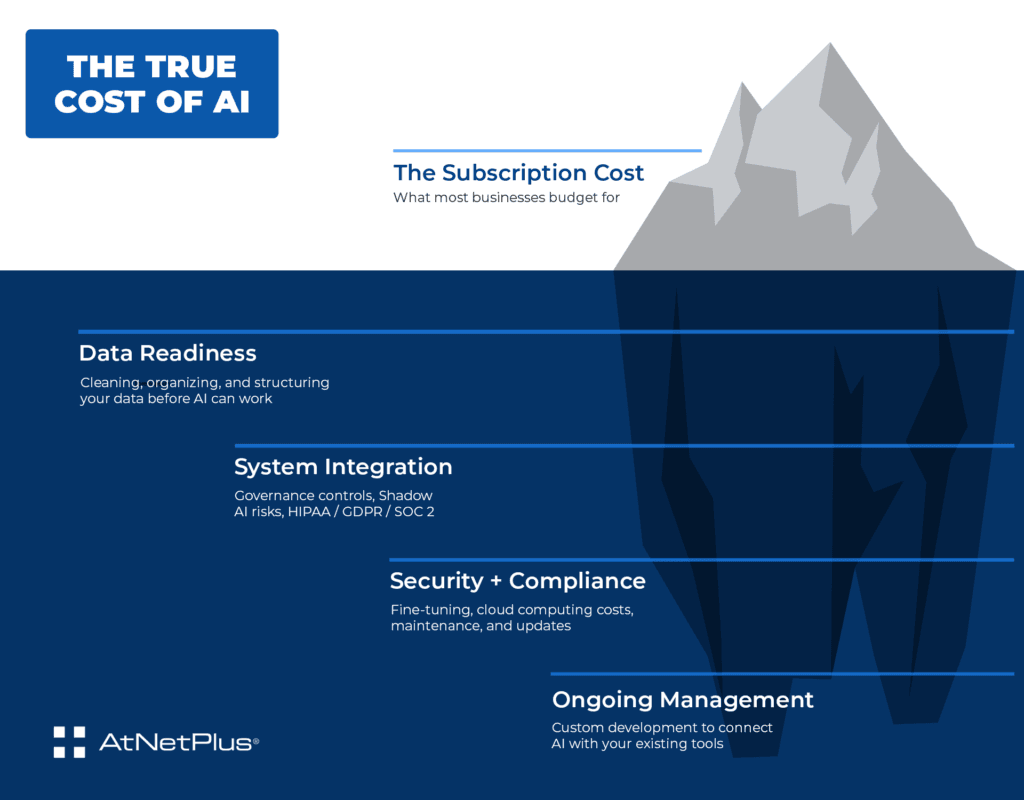
When most businesses think about the cost of AI, they think about the subscription. A Copilot license here, an AI-powered tool there. Those are real costs, but they’re just the tip of the iceberg.
Beneath the surface is where the real budget lives. If you’re not prepared for what’s down there, you can find yourself way over budget, behind schedule, and wondering what went wrong.
According to Gartner, 60% of AI projects that lack AI-ready data and proper AI infrastructure will be abandoned through 2026, due to poor data quality, inadequate risk controls, or escalating costs. That’s not a small number. That’s the majority.
1. Your Data Has to Be Ready First
Here’s something that catches almost every business off guard: AI is only as good as the information you feed it.
Before any AI tool can do its job safely and accurately, that information needs to be cleaned up, organized, and structured properly. That work takes real time, real people, and real money.
We’ve seen it happen over and over. A company invests in an AI platform, gets excited, and then realizes their data is in no shape to support it. The AI sits idle while six to twelve months, and thousands of dollars in consulting work, go toward simply getting the foundation ready.
The lesson: Before you spend a dollar on AI, take a hard look at the health of your data.
2. Getting AI to Play Nice With Your Existing Systems
Here’s another assumption that tends to bite businesses: “Our AI will just connect to the tools we already use.”
Sometimes that’s true. Often, it isn’t.
Many AI-powered business software systems, especially ones that have been customized over the years, weren’t built with modern artificial intelligence in mind. Getting them to talk to each other requires custom technical work. On top of that, most AI companies charge based on usage within their cloud computing platforms, and those costs can rack up fast in ways that aren’t always obvious when you’re signing up.
What starts as a $10,000 automation project can quietly become a full-scale custom software development effort, just to get the AI to communicate with the company’s existing tools. Before you know it, you’re not implementing AI anymore. You’re rebuilding infrastructure.
The lesson: Get a clear picture of your current tech environment before you commit to an AI solution, not after.
3. Security and Privacy Are Not Optional
This one keeps us up at night a little, and it should be on your radar too.
When employees get excited about a new AI tool, they use it. Sometimes without guidance, and sometimes in ways that weren’t intended. Sensitive client information, internal financial data, private employee records. These things can end up in places they should never be, often without anyone realizing it.
Even within approved enterprise AI tools, without the right controls in place, the wrong people can sometimes access information they shouldn’t.
Setting up AI securely means having real guardrails in place. Protections that keep sensitive data where it belongs, ensure you’re meeting your industry’s regulatory requirements, and give you visibility into how AI is actually being used across your organization. For businesses in healthcare, finance, or professional services, this also means staying aligned with frameworks like HIPAA, GDPR, and SOC 2.
A recent study found that more than 1 in 3 employees share sensitive work information with AI tools without their employer’s permission. That number should give every business leader pause.
Skipping this step isn’t just risky. It’s potentially catastrophic. The cost of a data breach, a regulatory fine, or reputational damage makes the cost of doing it right from day one look like pocket change.
The lesson: Security and governance aren’t add-ons. They’re the foundation.
4. AI Is Not a “Set It and Forget It” Tool
This might be the most underestimated reality of all.
AI isn’t like traditional software where you install it, train your team, and move on. AI tools evolve. The systems they connect to change. Your business processes shift. When any of those things happen, your AI setup needs attention.
There’s also the ongoing work of fine-tuning, adjusting how the AI is being instructed, optimizing it for accuracy, and troubleshooting when automations break. This isn’t a one-time project. It’s an ongoing operational responsibility.
There are also cloud computing costs that fluctuate based on the computational resources your AI consumes. Every query, every automation, every analysis draws on data centers running in the background, and those bills can surprise businesses that weren’t planning for them.
Without someone actively managing and maintaining your AI environment, things start to break. Workflows that employees once relied on suddenly stop working. People lose trust in the tools and quietly stop using them. All that investment goes to waste.
The lesson: Budget for the long haul, not just the launch.
Before You Invest in AI, Ask Yourself…
- Do we have an IT partner who understands both traditional infrastructure and modern AI?
- Is our data organized, consistent, and accessible?
- Do our current tools have the ability to connect to new AI platforms?
- Do we have a security plan specifically designed for AI use?
- Have we budgeted for ongoing management, not just the initial rollout?
So, What’s the Right Move?
None of this is meant to scare you away from AI. When it’s done right, it genuinely is as powerful as advertised. The businesses winning with artificial intelligence right now aren’t the ones who moved the fastest. They’re the ones who built the right foundation first and invested in AI-driven results intentionally.
That means understanding your data, knowing your systems, protecting your information, and planning for the road ahead, not just the ribbon-cutting moment.
That’s exactly where having the right IT partner makes all the difference. At AtNetPlus, we don’t just help you pick the tools. We help you map out the full picture upfront so there are no surprises hiding around the corner. From making sure your data is ready, to securing your environment, to managing the ongoing operational side, we’ve got it covered under a predictable, proactive model.
Ready to have that honest conversation about AI for your business? We’d love to talk.
AtNetPlus is a Managed Service Provider helping businesses across Ohio and South Carolina navigate technology with confidence, from everyday IT support to strategic AI planning.
FAQ | The True Cost of AI
Quick answers to what business owners and decision-makers ask most about AI costs and implementation.
Q1: What are the hidden costs of implementing AI in a business?
Beyond the subscription or license fee, the hidden costs of AI typically fall into four categories: data readiness (cleaning and organizing your existing information), system integration (connecting AI to your current tools and software), security and compliance (setting up proper controls and governance), and ongoing operational overhead (managing cloud computing costs, fine-tuning, and troubleshooting). These costs are often underestimated and can significantly exceed the initial licensing investment. Building the right AI infrastructure from the start is what separates successful deployments from expensive mistakes.
Q2: What is data readiness and why does it matter for AI?
Data readiness refers to how clean, organized, and accessible your business data is. AI-powered tools depend entirely on the quality of the information they can access. If your data is scattered across multiple systems, inconsistent, or outdated, the AI can’t perform accurately. Many businesses discover after purchasing an AI tool that they need to spend months, and significant consulting budget, simply preparing their data before the AI can be used effectively.
Q3: What is ‘Shadow AI’?
Shadow AI refers to employees using AI tools on their own, outside of any company-approved or IT-managed environment. When this happens, sensitive information such as client records, financial data, or proprietary business details can be inadvertently shared with public AI platforms. A recent study found that more than 1 in 3 employees share sensitive work information with AI tools without their employer’s knowledge. Without proper oversight, this creates serious data privacy and compliance risks.
Q4: Is AI a one-time cost or an ongoing expense?
AI is an ongoing operational expense, not a one-time purchase. In addition to subscription fees, businesses need to account for cloud computing costs (which fluctuate based on the computational resources your AI consumes), continuous fine-tuning and optimization, IT support for maintaining integrations, and updates as the tools and business processes evolve. Behind every AI-powered workflow are data centers processing requests around the clock. Organizations that don’t plan for this ongoing investment often find themselves caught off guard by monthly bills or broken workflows.
Q8: Do I need an IT partner to implement AI safely?
While it’s technically possible to implement AI tools without an IT partner, doing so significantly increases the risk of budget overruns, security gaps, and failed deployments. An experienced Managed Service Provider that understands both traditional IT infrastructure and modern artificial intelligence can help you assess your data readiness, plan integrations properly, build out your AI infrastructure, set up security and compliance controls, and manage the ongoing operational overhead, all under a predictable, proactive cost model.
Q9: Is my business is ready for Artificial Intelligence?
A good starting point is asking yourself five questions. Is our data organized and accessible? Can our current systems connect to new AI platforms? Do we have a security plan for AI use? Have we budgeted for ongoing management, not just the initial setup? And do we have the right IT support to guide us through implementation and beyond? If you can’t confidently answer yes to all five, it’s worth having a conversation with an IT partner before moving forward.
Still have questions on the true cost of AI? We’re happy to help.
Sources:
- Lack of AI-Ready Data Puts AI Projects at Risk | Gartner